Scottish Clan Council of Houston

Since 1985 providing the most current information available about Scottish and other Celtic activities, primarily in the Greater Houston Area, and Texas at-large...

HOME * FLOWERS OF THE FOREST *  VISIT THESE "WHO's WHO" LINKSPHOTOS *  ABOUT *

Melvyn Douglass, FSA Scot (Director) - 713-871-0061 (24-hrs) 281-596-4513 (fax)

Image result for facebook logos for website!


NEWSWORTHY


  Date: 22 January 2008 - Reuters

Haggis ban an offal burden?


Date: 11 January 2007
Author: Lucy Robb

Scottish youngsters to meet Space Shuttle crew

A group of 26 young Scottish scientists will tomorrow (12 January 2007) embark on a mission to NASA's base in Houston, Texas and meet the crew of the Space Shuttle Discovery. The teenagers are all students of the Careers Scotland Space School, an inspirational programme that encourages young people to follow careers in science and technology.

The ten day residential space school will open its doors on Friday 12 January 2007, when the fourth and fifth year pupils set out from Glasgow Airport and travel to NASA's Johnson Space Center in Houston. A highlight of the trip will be meeting British astronaut Nick Patrick and the space shuttle crew who spent 13 days in space last month.

The Careers Scotland Space School is a world leading programme supported by the Scottish Executive and NASA. It is designed to increase participation and motivation of school students in science and technology and help young people to understand how the subjects apply to real career choices.

For ten inspirational days the young people will work with a team of NASA astronauts and scientists and participate in a mixture of lectures, workshops, group tasks and assignments, alongside a full social programme. They will view NASA facilities and Nick Patrick will provide a guided tour of the historic mission control that was used during the Apollo space flights.

The teenagers have been selected from 3,000 young people who took part in the Careers Scotland Space School programme last year. They have all successfully completed a programme of distance learning developed by Careers Scotland in conjunction with a team of NASA scientists. Designed to supplement studies in Higher Grade physics, chemistry, biology and maths, the Careers Scotland Space School aims to further develop the young people's skills and knowledge in science, technology and enterprise.

Alex Blackwood, head of enterprise in education, Careers Scotland, said: "Now in its sixth year, the Careers Scotland Space School is repeatedly described as an inspirational and life changing experience. Science and technology are vital to the success of Scotland’s economy and Careers Scotland aims to motivate young people and encourage them to study the subjects and go on to choose them as careers.

"Inspiring young people is something that NASA scientists do better than most and I am sure that the Careers Scotland Space School students will enjoy their trip of a lifetime. Not only will the young people develop their skills in science and technology but they will also increase their confidence, motivation and self-belief. More than 80 per cent of young people who have participated in the Careers Scotland Space School have gone on to university to study science and technology."

On his flight aboard the Space Shuttle Discovery, Nick Patrick carried a Saltire into space in recognition of his support for the Careers Scotland Space School. He plans to return it to Scotland later this year.

Media contact

Lucy Robb
Careers Scotland Press Office
Tel: 0141 228 2995 / 07887 628732


August 13, 2006 - New York Times

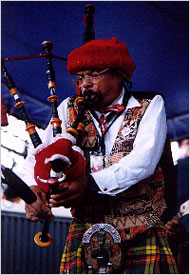
Rufus Harley, 70, Dies; Adapted Bagpipes to Jazz

Rufus Harley, who was billed as “the world’s first jazz bagpiper” and emitted his haunting sounds alongside some of the greats of jazz, died on Aug. 1 in Philadelphia, his hometown. He was 70.

The cause was prostate cancer, his son Messiah Patton Harley said.

Although Mr. Harley fully acknowledged that “everybody thought I was crazy” when he turned to bagpipes in the early 1960’s, he became a frequent sideman on records and in concerts with saxophonists like Sonny Rollins, John Coltrane, Dexter Gordon and Sonny Stitt, with the trumpeter Dizzy Gillespie and with the flutist Herbie Mann.

“He adapted the bagpipes to jazz, blues, funk and other typically African-American styles, while also acknowledging the instrument’s Scottish roots,” said David Badagnani, an instructor at the Center for the Study of World Musics at Kent State University.

Mr. Harley, who was 6-foot-2, was of African-American and Cherokee descent; he sometimes performed in Scottish kilts, sometimes in a dashiki and a Nigerian kufi, or skull cap.

In 1967 a New York Times review of a concert given by Mr. Mann, with Mr. Harley by his side, said that the bagpipe’s tones “sounded far more Middle Eastern than Scottish,” and that when combined with the flute, “the two wind instruments blended into an eerily swinging ensemble.”

Rufus Harley Jr. was born on May 20, 1936, outside of Raleigh, N.C. His family moved to a poor neighborhood in North Philadelphia when he was 2. He is survived by 16 children and 15 grandchildren. He and his wife, Barbara Jean Jones, separated many years ago.

As a teenager, Mr. Harley sold newspapers to buy a saxophone so he could play in his high school band. At 16 he dropped out of school and worked at odd jobs to help support his family. But he never lost interest in music. For 10 years he took lessons on the saxophone, oboe, trumpet and flute and played in local jazz clubs.

The turning point came in November 1963, as Mr. Harley watched the funeral procession for President John F. Kennedy on television and was taken by the wailing sound of the Black Watch bagpipe band. He tried, unsuccessfully, to reproduce the sound on his saxophone.

“My dad was playing a lot of tenor sax then,” his son Messiah said, “but because Coltrane and Rollins were smoking the sax, that’s why he turned to the bagpipes.”

A friend who knew of Mr. Harley’s interest spotted a used bagpipe in a pawnshop and, after a quick phone call, covered its $120 price. After months of practice, Mr. Harley was working in local clubs, and his unusual talent gained wider attention.

From 1965 to 1970, Mr. Harley was the lead artist on four albums on the Atlantic label. He began making appearances on television shows, including “To Tell the Truth,” “What’s My Line?” “I’ve Got a Secret, ” Johnny Carson’s “Tonight Show” and Bill Cosby’s “Cosby Show.” He accompanied the singer Laurie Anderson on her 1982 album “Big Science.” And in 1995 he worked with the hip-hop band the Roots on its album “Do You Want More?!!!??!”

All the while, Mr. Harley insisted that the bagpipe had African roots and that his chosen instrument had helped him “discover my identity by making me aware of my cultural heritage.”

In fact, Mr. Badagnani at Kent State noted, “there are double-pipe instruments in the Museum of Egyptian Antiquities in Cairo that resemble a bagpipe.”

http://www.nytimes.com/2006/08/13/arts/music/13harley.html


Google

©2004-2015 Melvyn Douglass; Scottish Council; All Rights Reserved.
Click Here if you own, operate or maintain your own Website
For corrections/additions contact Webmaster
This website last updated: Sunday, April 12, 2015 01:20 PM

website statistics